404: Democracy Not Found
Museum of the Retired Newsroom: Reimagining Local News as Civic Infrastructure
For Del Rio, Texas, the collapse of its local newspaper wasn’t just a business failure – it was a community crisis. In late 2020, the Del Rio News-Herald printed its final edition, leaving this border city with no dedicated local news source. Almost overnight, a population of roughly 49,000 lost a vital civic forum, creating what journalists call a “news desert” – and what we might call a civic blind spot. Del Rio’s story is far from unique; it’s a vivid case study of a nationwide problem and a springboard for design-driven action.
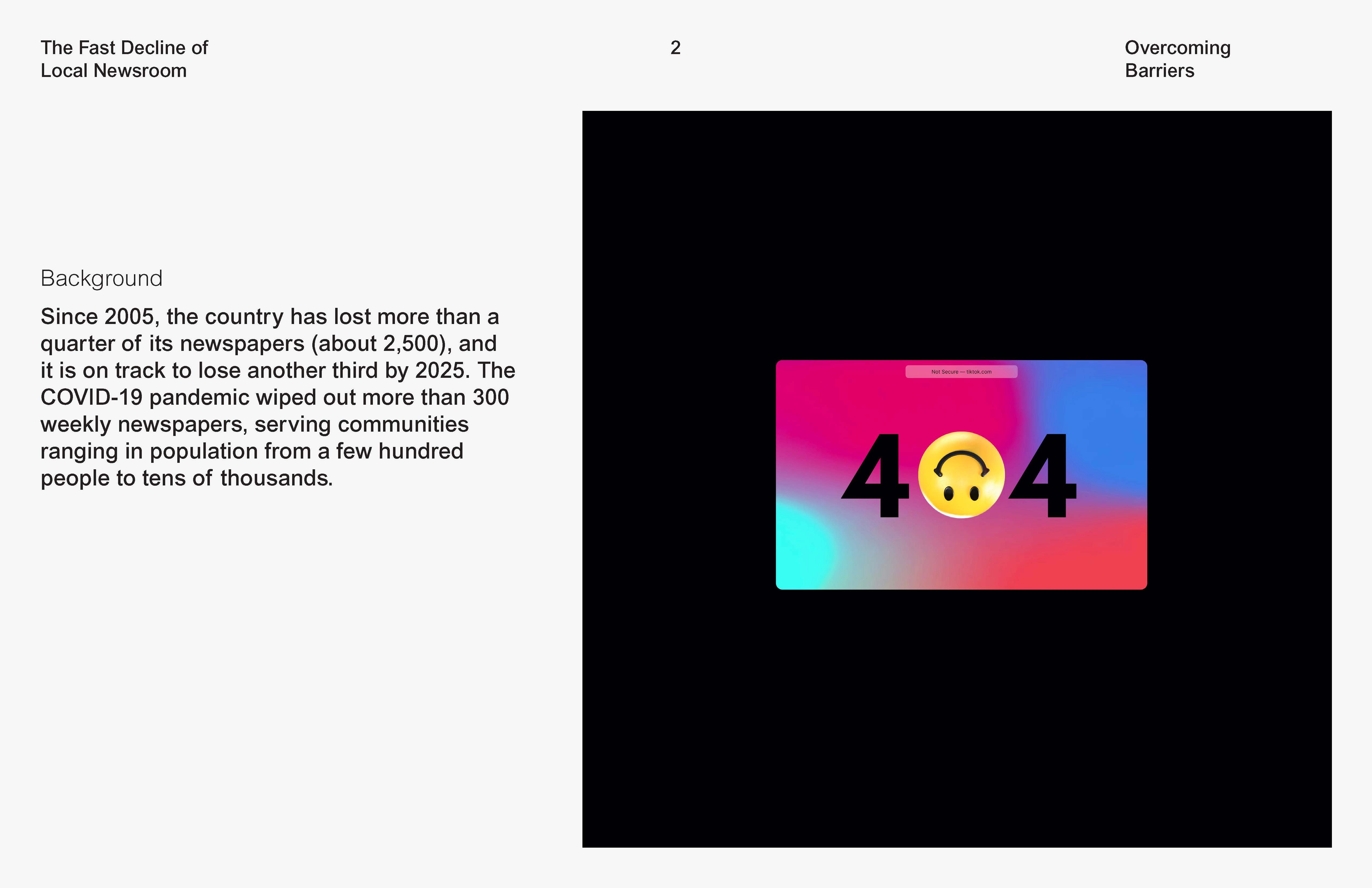
A stylized “404 error” face represents the disappearance of a local newsroom – an error in the civic information flow. Since 2005, the United States has lost over 2,500 local newsroomstexastribune.org – more than a quarter of all its newspapers. And it’s not slowing down: at the current pace, we’re on track to lose one-third of our newspapers by 2025texastribune.org. The COVID-19 pandemic alone wiped out more than 300 weekly paperstexastribune.org, accelerating an already steep decline. Each closure leaves behind a void where community stories, watchdog journalism, and local feedback loops used to thrive. It’s as if whole communities have been hit with a “News Not Found” error, with no easy fix.
Local Newsrooms: Falling Off a Cliff
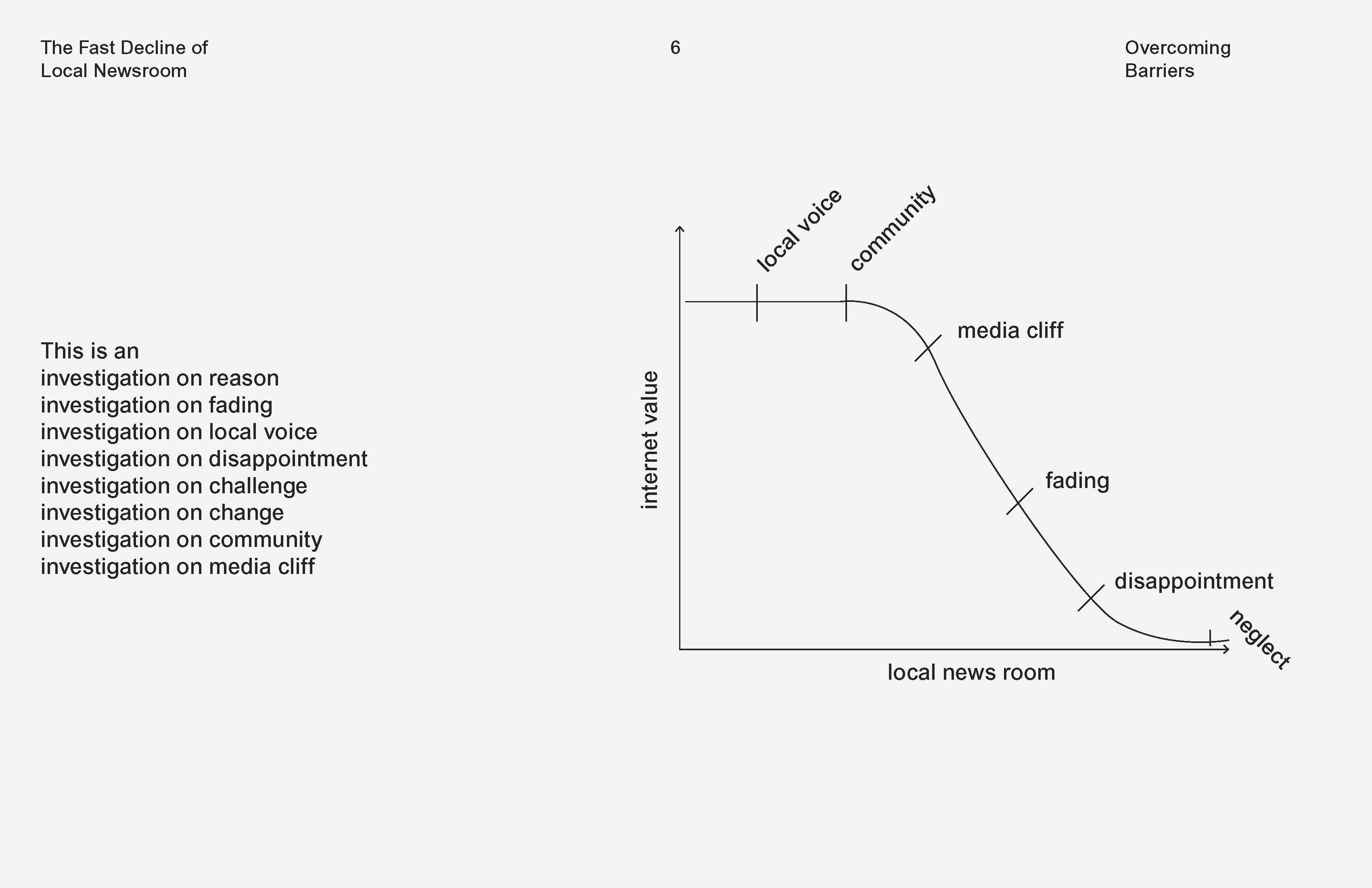
Local journalism didn’t just gradually fade away – in many places it fell off a cliff. The rise of the internet and social media led to an abrupt drop in traditional news revenue and readership, pushing many outlets over a “media cliff.” As advertising moved online and reader attention shifted to big platforms, even long-standing newspapers suddenly found themselves in freefalltheweek.comtheweek.com. In this freefall, community voices that once informed and bound together towns began to fade, leading to public disappointment and eventually widespread neglect of local issues. The graph below visualizes this trajectory – a sharp plunge from a once-steady plateau of community news engagement to a chasm of silence.
Conceptual “media cliff” diagram: local news (and its “local voice” and community presence) stays steady, then drops precipitously. Once the newsroom falls off this cliff, engagement quickly fades, public trust turns to disappointment, and community attention sinks into neglect.
What caused this plunge? A perfect storm of factors built up over the years, undermining the foundation of local media. Imagine these factors as a series of stacked barriers that grew higher and higher, making it harder for local newsrooms to survive:
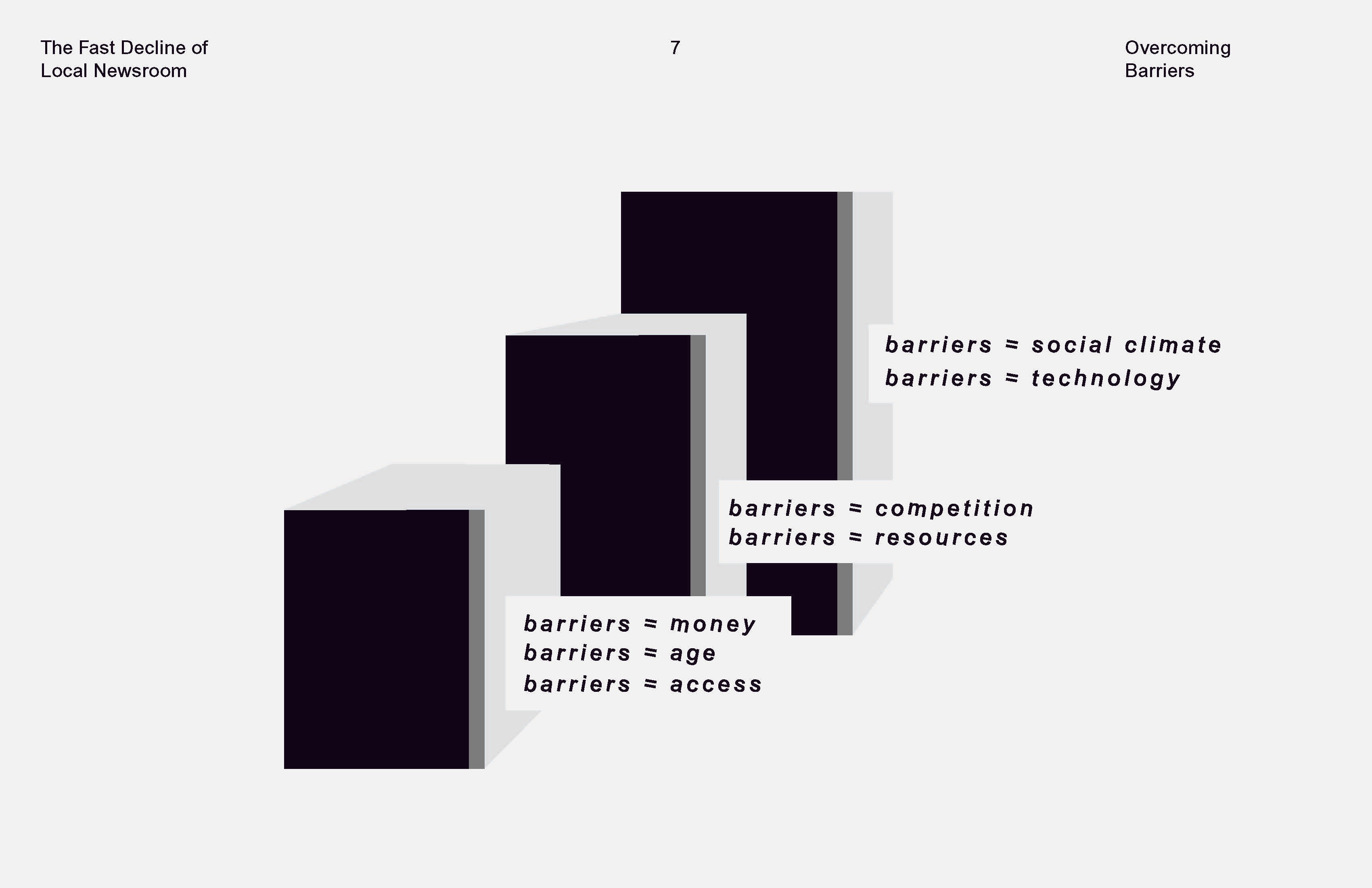
Stacked barriers diagram: local newspapers faced multiple hurdles – from financial strains to technological upheaval.
Financial Freefall: Advertising revenue dried up (dropping from $49B in 2006 to $14B in 2018theweek.com), leaving many papers without sustainable funding (money barrier).
Aging & Access Gaps: Many traditional readers were older, and younger audiences weren’t subscribing. At the same time, rural and small communities often lack affordable broadband, limiting digital news access (age and access barriers).
Digital Competition: Big tech platforms and social media soaked up attention and ad dollars, outcompeting local papers (competition and technology barriers).
Resource Strain: Newsroom staff and resources were slashed by corporate owners or hedge funds seeking quick profittheweek.com, leaving “ghost newspapers” with almost no reporters. Small papers simply couldn’t cover everything (resources barrier).
Social Climate: Public trust in media eroded amid polarization and misinformationtexastribune.org, making the job of local journalism even tougher (social climate barrier).
With barriers like these, it’s no surprise that hundreds of communities went from having vibrant local news to nothing at all. And when a community loses its newspaper, it loses more than stories – it loses a piece of civic infrastructure. The familiar feedback loop between citizens and leaders (think: “Town council debates new park, newspaper reports it, residents discuss and respond”) breaks down. In many places, that loop has not been replaced by anything else.
Del Rio, TX: A Community in the Dark
Del Rio exemplifies what happens on the other side of the media cliff. Val Verde County (home to Del Rio) saw its newspaper circulation drop 43% from 2005 to 2019, even before the final blow. When the News-Herald closed in 2020texastribune.org, it left the entire county with no newspaper and not even a local TV stationexpressnews.com. The civic conversation went eerily quiet. Local officials suddenly had no dedicated channel to get information out, and residents had to rely on word-of-mouth and sparse social media for news. As Del Rio’s mayor noted at the time, older residents especially “are going to feel disconnected” without a local paperexpressnews.com.
Efforts to fill the gap have emerged – for example, a new weekly paper, The 830 Times, launched in 2021 to cover Del Rio’s happenings. But it publishes mainly in English, while about two-thirds of Del Rio’s residents speak Spanish at home. In fact, around 66% of the community is Spanish-speaking, and roughly 52% of residents are non-U.S. citizens, many of whom rely on Spanish-language news. Combine that with 16% of the population living in poverty (versus 11% nationally), and you have a community that is hard to reach and underserved when information isn’t tailored to them. An English-only solution can only go so far in a city that is bilingual and multicultural by nature. Del Rio’s “news desert” isn’t just about lack of news, but the lack of accessible, relevant news – a true data desert where important stories can vanish without a trace.
This scenario underscores a critical point: losing local news creates a blind spot in civic life. Issues like water quality, school events, public health updates, or local elections might go unreported and unnoticed. The community’s ability to make informed decisions suffers. In design terms, a key feedback mechanism in the civic system has broken. So how might we restore it? Enter the Museum of the Retired Newsroom.
Designing the Museum of the Retired Newsroom
Faced with the void left by shuttered newsrooms, a team of strategic designers and civic technologists took a creative approach: what if we archive the loss to spark action? They created a speculative prototype called the Museum of the Retired Newsroom – a kind of civic archive for all the local newspapers that have vanished. Think of it as a digital museum where each exhibit is a community that lost its paper. The team’s challenge was twofold: first, finding and collecting data on all those shuttered newsrooms (no small feat, since no one entity tracks every closure); and second, quantifying the impact of losing a local news source in a way that people can grasp emotionally, not just intellectually.
The Museum of Retired Newsroom – a prototype online platform that showcases “artifacts” of closed local papers. Here, visitors can browse final front pages and headlines (like The Villager in NYC or the Warroad Pioneer in Minnesota) and reflect on the stories that ended when those newsrooms shut down.
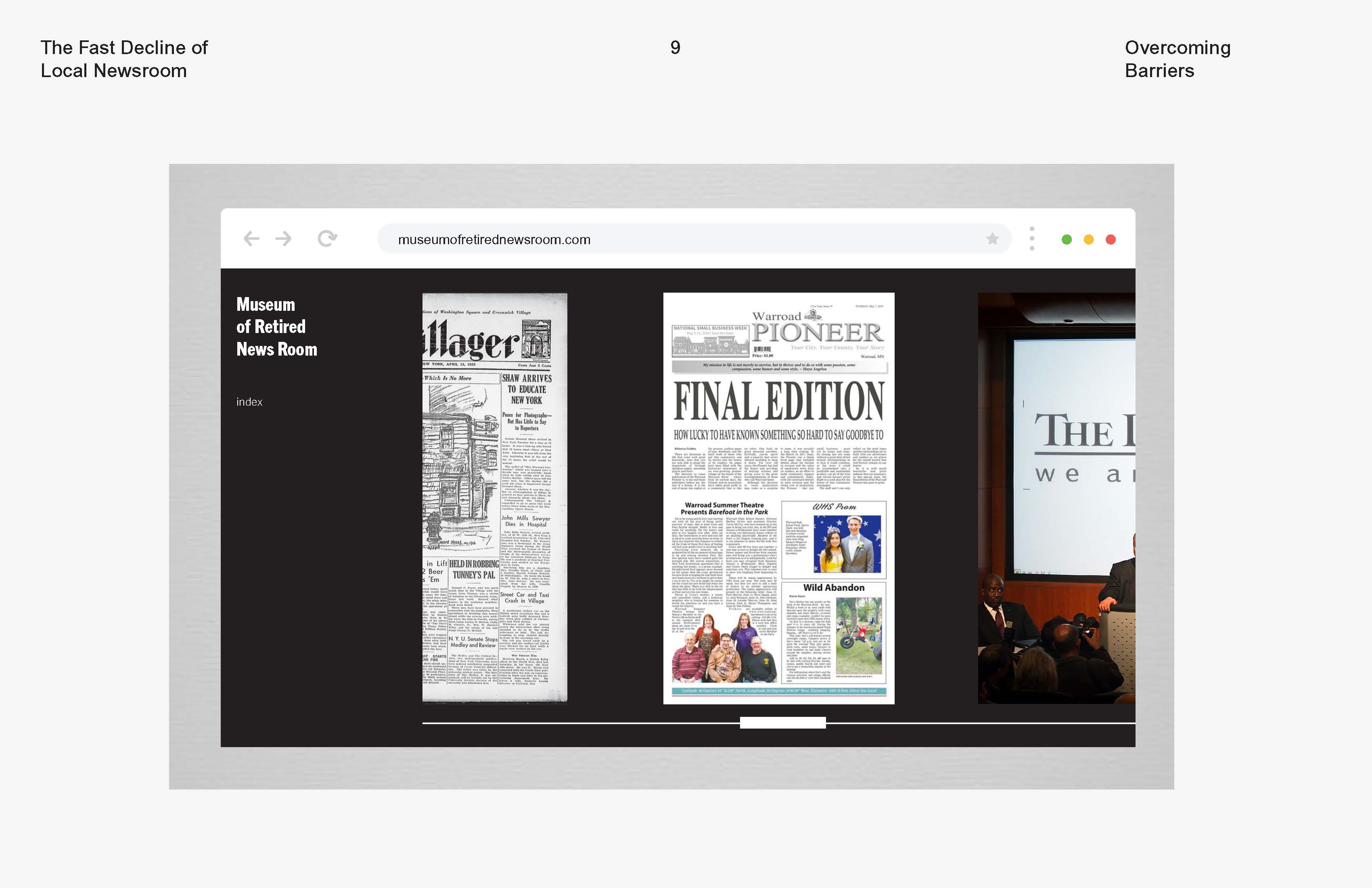
On the Museum’s website, you can scroll through a gallery of final editions and front pages marked “Final Edition” – each one the last gasp of a local paper. It’s both memorial and proof-of-concept. By preserving these artifacts, the Museum makes the problem visible and tangible. You can’t help but feel the poignancy seeing a front page headline announce a paper’s own closure. It’s a stark reminder that this town no longer has a watchdog or a storyteller. The design is simple and bold, treating these newspaper pages like exhibits in an art gallery – because in a way, they are artifacts of our civic infrastructure.
The project also included a physical installation, translating the data into a three-dimensional experience. In one exhibit, a field of tall, thin shards represents the multitude of closed newsrooms, and a large hovering sphere suggests the looming, precarious state of community information. It’s a visual metaphor for fragmentation – many small voices cut down, with a hollow space now hanging over communities. By speculatively “archiving” what’s been lost, the design invites us to ask: What will we do to fill this void?From Data Access to Data DemocracyThe Museum of the Retired Newsroom isn’t just looking backward; it’s provoking us to look forward and rethink data democracy.
Traditionally, efforts to address news deserts focus on providing access to information – for example, creating open data portals or encouraging big media outlets to cover underserved areas. But access alone doesn’t guarantee understanding or engagement, especially if that information isn’t relevant, local, and community-driven. Del Rio’s plight shows that simply having the internet or a Facebook group isn’t a substitute for the deep local knowledge and trust a hometown newspaper provided. Data democracy means empowering communities to actively participate in creating, sharing, and preserving the information that matters to them. It’s about designing tools and systems so that the people – not just institutions or algorithms – have a say in their data and news. In the context of local news, that could mean community-curated news boards, neighborhood storytelling platforms, or local data hubs maintained by residents.
The Museum prototype illustrates this principle by honoring community stories and implicitly asking locals to share their own memories of these papers. It shifts the narrative from “We’ve lost access to news” to “We collectively own our stories – and we can design new ways to tell them.” In other words, the path forward is not to replace the old one-way broadcast model with another top-down solution, but to co-create a new model with the community at the center.
The Museum of the Retired Newsroom shows the power of design to reframe the problem: the goal isn’t just bringing back newspapers; it’s rebuilding the ecosystem of civic information in whatever new form works for the community.Call to Action: Rebuilding Civic InfrastructureThe collapse of local news is a design problem as much as it is a journalism problem. It calls for strategic designers, civic technologists, and community organizers to team up and build hyperlocal, culturally tuned, community-powered tools that restore our civic feedback loops.
Here’s how we can start:Hyperlocal Focus: Design solutions at the scale of neighborhoods and small cities. One size does not fit all – each community has unique information needs. A hyperlocal approach might mean a network of micro-newsletters, SMS news blasts in areas with low internet, or a bulletin-board app for one particular town. The key is to meet people where they are, on issues they care about.
Culturally Grounded: Meet communities in their own language and context. In Del Rio, that means news in Spanish and reflecting border culture; elsewhere it might mean using local dialects, references, or community moderators who know the area. Design with an appreciation for local identity so that new information tools feel welcoming and trustworthy.
Community-Driven: Go beyond designing for people – design with people. Engage community members as co-creators of their news platforms. This could involve citizen reporters, crowdsourced data projects, or cooperative-owned news hubs. When residents help shape the tool, they’re more likely to use it and trust it. Community ownership is the ultimate antidote to the top-down, out-of-touch failures that helped create news deserts in the first place.
The bottom line: We must treat local information as critical civic infrastructure – just like parks, libraries, or water systems. When it breaks, our communities break. The Museum of the Retired Newsroom project reminds us what’s at stake by spotlighting the void left behind. Now it’s on us, as designers and civic innovators, to fill that void with creative, inclusive solutions. It’s time to turn “News Not Found” into “News: Rebuilt.” Each of us has a role to play in rebuilding data democracy from the ground up, one community at a time.
Citations
Since 2005, Texas has lost more journalists per capita than all but 2 states | The Texas Tribunehttps://www.texastribune.org/2022/06/29/death-local-news-texas/The demise of local news | The Weekhttps://theweek.com/briefing/1020220/the-demise-of-local-newsThe demise of local news | The Weekhttps://theweek.com/briefing/1020220/the-demise-of-local-newsThe demise of local news | The Weekhttps://theweek.com/briefing/1020220/the-demise-of-local-newsSince 2005, Texas has lost more journalists per capita than all but 2 states | The Texas Tribunehttps://www.texastribune.org/2022/06/29/death-local-news-texas/Coronavirus pandemic claims nearly century-old Del Rio News-Heraldhttps://www.expressnews.com/news/local/article/Pandemic-claims-Del-Rio-News-Herald-15737215.phpCoronavirus pandemic claims nearly century-old Del Rio News-Heraldhttps://www.expressnews.com/news/local/article/Pandemic-claims-Del-Rio-News-Herald-15737215.php
date published
Oct 28, 2024
reading time
404: Democracy Not Found